
Approved at 12:20, On the Easel That Afternoon: Two A1 Boards for a City Reception
020 3375 6674 info@silverimagelondon.com Open 24 hours, 7 days a week — call or email and we will tell you what is possible today.
A City insurance broker on Bury Street, EC3A in the City of London, needed two A1 boards for an investor reception. Proofs went over late morning, artwork was approved at 12:20, the courier was booked at 13:28, and the boards were on their easels that afternoon. Nothing about the print was hard. The client’s real question was the one worth writing down: will this arrive before my receptionist goes home?
Written by Maciej Antosz, Production Manager at Silver Image London ·
This is an account of one job, not a turnaround promise. Send us yours and we will come back with a firm figure.
A Wednesday, start to finish
Sixty-eight minutes from approval to courier: A1 foam board printing, trimmed, packed and delivered into EC3A within the afternoon. The times below are as they sit in the email thread. Read the gaps rather than the entries: the whole job occupies one working afternoon, and most of it is waiting on people, not on presses.
| When | What happened |
|---|---|
| Late morning | Proofs sent over for sign-off — two boards, agenda layout, event branding. |
| 12:10 | “Would you mind resending the image?” The first attachment had not come through. Thirty seconds of work, and the reason it matters is that it happened before production rather than after delivery. |
| 12:20 | “Yes, that’s perfect. Please can we proceed.” Artwork approved; the boards went straight onto the flatbed. |
| Shortly after | Invoice raised and paid. On a same-day job we raise it the moment the spec is fixed, so payment is never the thing holding the courier. |
| 13:28 | Courier booked, confirmation to the client automatically. |
| That afternoon | Two A1 boards delivered to reception on Bury Street, inside office hours. |
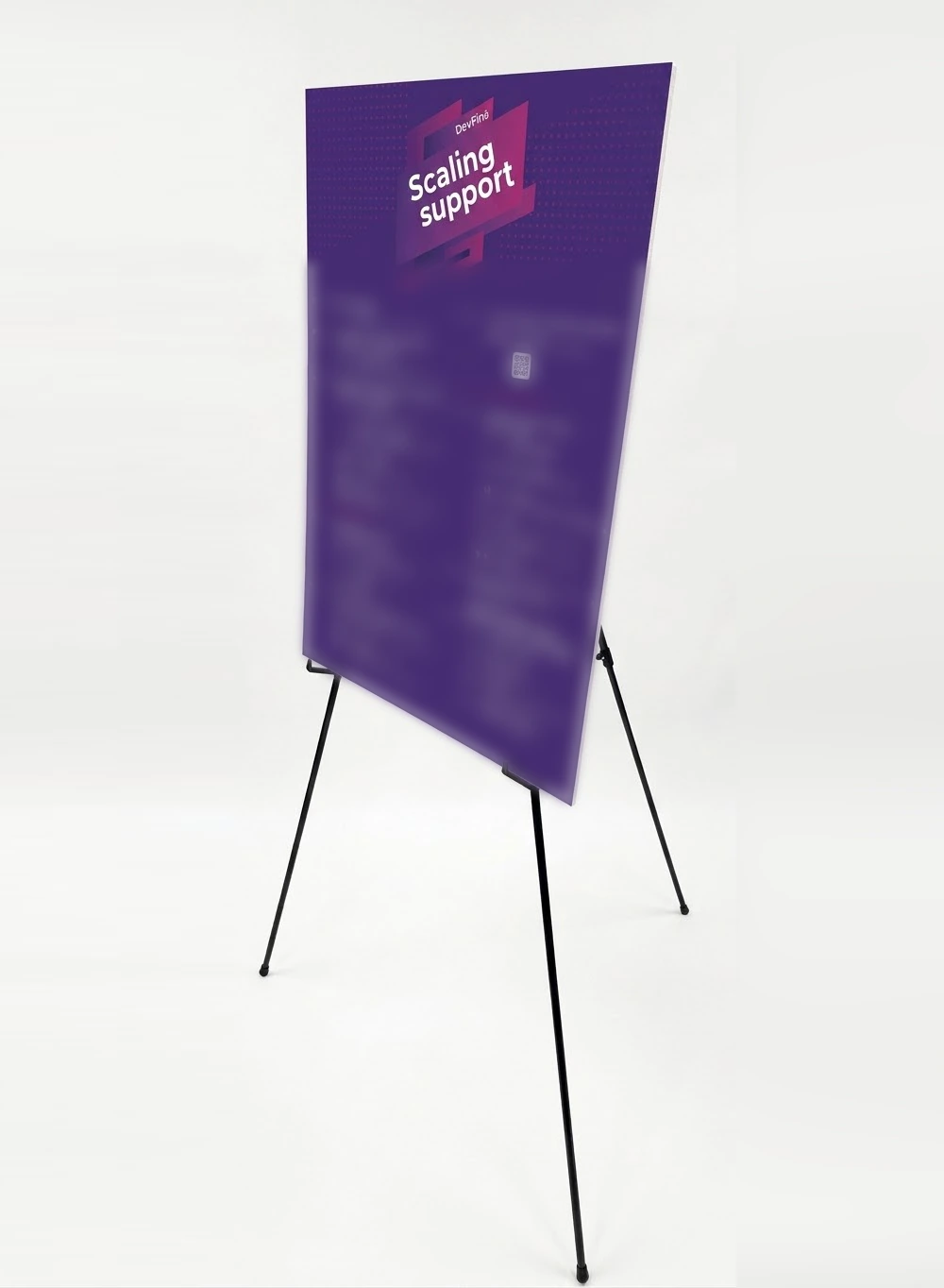
Written up from the email thread. The client is not named, nobody on the thread is named, no figures from the invoice are published, and the delegate names printed on the boards are blurred in the photograph. The postcode, the format and the timings are, because they are the work.
What a 24-hour floor actually buys a midday order
Most people picture 24-hour printing as somebody running a press at three in the morning. That happens, and it is the overnight service. But the more useful thing a round-the-clock floor does is quieter, and this job is the example: it makes the middle of the day elastic.
A print shop that closes at six has to fit every job into one shift. Work arriving at noon queues behind work that arrived at nine, because the day is a fixed-size box. A floor that runs continuously does not have that box. The overnight run absorbs the backlog, which is precisely what leaves capacity free for something approved at 12:20 to go on press at 12:21. The night shift is not only for night work — it is what stops the day queue from existing.
That is why the honest answer to “can you do this today?” is almost never about the machine. It is about what else is already on it.
The question that actually decides a same-day delivery
The most revealing line in this thread was not about print at all. It was: “let me know when it’s en route and give me a rough ETA, just so I can let reception know, or make sure I am still here to receive it if our receptionist has gone home.”
Every same-day job in an office building runs into this. A delivery that arrives at 17:45 to a reception that closed at 17:30 has failed just as completely as one that never printed. Same-day is a door-open problem as much as a production one, and the fix is boringly practical: tell us the hour the door closes, and we will schedule the courier against that, not against our own finishing time.
The same applies at the other end of the day. If you are ordering for a breakfast event, the relevant deadline is when the venue lets you in, not when the doors open to guests. Say the hour, not the day — and if there is nobody to sign, say that too, because a named contact and a phone number are what turn a locked lobby into a delivery.
Why A1 on foam board, for a reception
A1 is 594 by 841 mm — big enough to be read across a foyer, small enough that one person carries it and a standard folding easel holds it without complaint. It is the default size for agendas, welcome boards and seating plans for exactly that reason.
The board in the photograph is printed onto rigid foam board, which is what lets it stand on an easel with no frame and stay flat all evening. Paper or mounted card in that size curls within the hour under warm lighting, and the curl always starts at the corner nearest the door. If the board has to survive being carried between rooms, or live outdoors near an entrance, a-boards and weatherproof grades are the next question — but for an indoor reception, foam board on an easel is the whole answer.
One practical note on artwork: agendas printed at A1 are read from about a metre and a half away, so body text below roughly 18 pt stops being legible in the room even though it looks fine on a laptop. Sizes and stock options are on the large format printing page.
Delivering into the City
Bury Street sits in EC3A, a few minutes from Bank and Monument and a short walk from Liverpool Street — the densest part of our courier map, and the reason afternoon deliveries into the Square Mile are routine rather than exceptional. Work heading for Fleet Street and the legal quarter travels the same route most days.
The practical consequence for anyone ordering from an office in the City: the drive is rarely the constraint. The constraint is the hour your building stops accepting parcels.
If you need boards for an event this afternoon
- Send the artwork with the enquiry, not after it. The clock starts when the file lands. This job was approved at 12:20 because the proof was already sitting in the inbox at noon.
- Say the hour the door closes. Reception hours decide the courier slot. “Today” and “before 5pm, someone is there until 5:30” are different instructions, and only one of them is plannable.
- Give a name and a mobile for the delivery. If the receptionist has gone, somebody has to be reachable. This is the single most common reason a same-day job sits in a van.
- Check the proof properly, once. One round of “can you resend that?” before press costs two minutes. One round after delivery costs the event.
- For agendas, size the type for the room. A1 is read at a metre and a half. If it works at arm’s length on a screen, it is probably too small on the easel.
Sizes and thicknesses are on the foam board printing page, and if the deadline is inside the working day, same day printers covers what is possible and when.
Related services
Send us the job
Tell us the size, the quantity and the hour it has to be there. We come back with a firm price, and we check the artwork before anything goes on press.
Open 24 hours, 7 days a week. Same-day and overnight delivery across London.
SAP Business Network member registered member
