
Mail Merge Place Cards on Short Notice
020 3375 6674 info@silverimagelondon.com Open 24 hours, 7 days a week — call or email and we will tell you what is possible today.
A corporate marketing team emailed on a Friday afternoon for place cards to be on the table at a client breakfast in an office in the City on Monday morning. Twenty guests, name above company, names supplied as a spreadsheet. Quote, proof, two corrections, payment and courier — the whole place card printing job ran across the weekend, and the cards were signed for at 12:02 on the Monday.
This is an account of one job, not a turnaround promise. Send us yours and we will come back with a firm figure.
Enquiry to courier, hour by hour
The times below are as they sit in the email thread. Nothing here is rounded, and nothing has been moved to make the sequence look tidier than it was.
| When | What happened |
|---|---|
| Fri 15:19 | Enquiry in. Twenty guests, name above company, name bold and larger. Guest list attached as a CSV, with a screenshot of the layout they wanted. |
| Fri 16:36 | Acknowledged, proof promised for the next day. |
| Sat 12:49 | Proof out with nineteen of the twenty names set in the artwork, and a question about the twentieth. |
| Sat 13:38 | Approved. The twentieth guest had dropped out anyway. They asked to see what the card itself would look like. |
| Sat 13:54 | Stock confirmed as 400 gsm smooth uncoated in a light off-white. Folded face offered at business card size, A7 or A6. |
| Sat 14:07 | They asked whether that size was the face or the flat sheet, and which side folds over. |
| Sat 14:22 | Answered, and a second proof sent showing the name printed on both faces rather than one. |
| Sat 14:49 | Both approved — business card face, name on both sides. |
| Sat 15:38 | Final proof and invoice out. Delivery address and a named recipient requested for the Monday drop. |
| Sat 15:55 | One correction: a surname that had been shortened to an initial on the list. Delivery details supplied. |
| Sat 16:03 | Corrected proof out, and confirmation that the second layout carried no price difference. |
| Sat 22:25 | Paid. |
| Mon 10:30 | Bike courier booked to arrive at 10:30, addressed to the named recipient. Twenty cards across town is a bike job, not a van — and a bike is the only thing that holds a morning slot in the City with any confidence. |
| Mon 12:02 | Signed for. The docket carries the security officer’s signature, not the recipient’s: in a City tower the parcel stops at the ground-floor desk and is logged there. Worth knowing when you set a deadline — the time that matters to the building is when reception takes it, and the last leg from that desk up to the floor is not on anyone’s clock. |
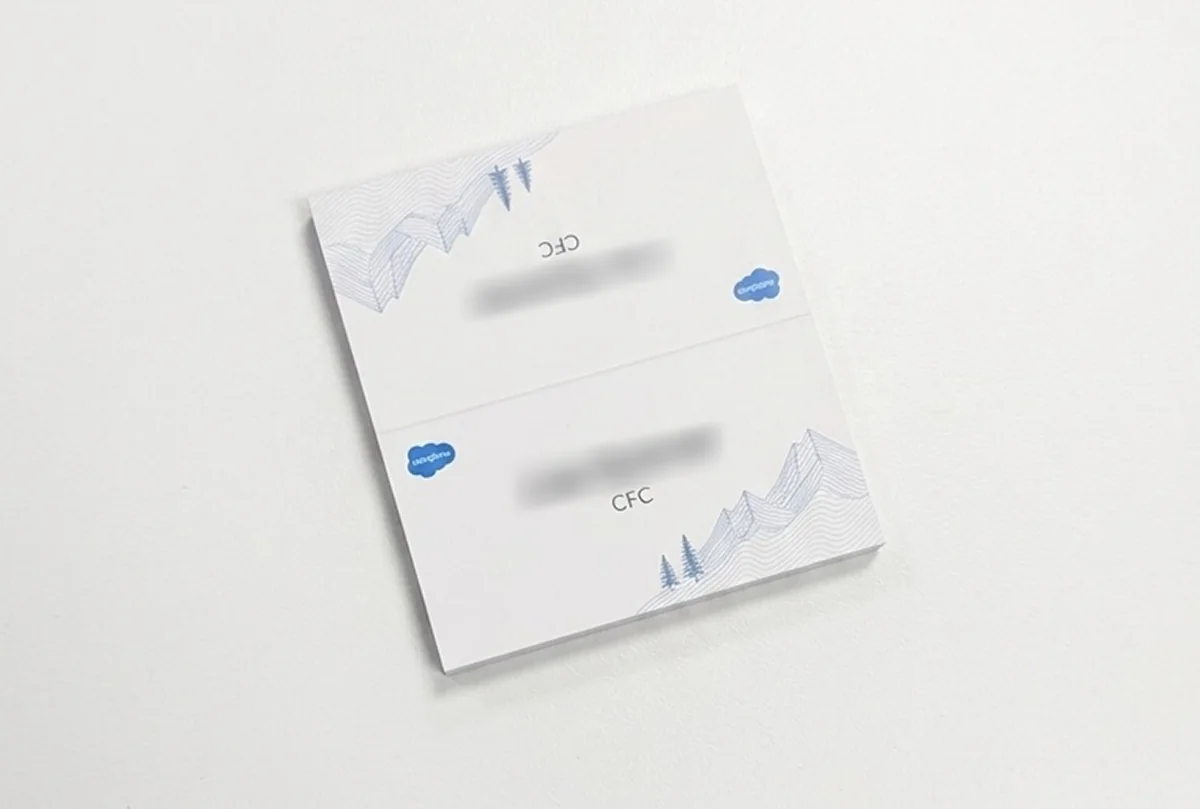
Written up from the email thread, the invoice and the courier booking. Guest names are blurred in the photograph — the people on those cards were not party to the job and were never asked — and the cards themselves went out with every name printed in full. The last two lines come from the courier docket: a booking placed for 10:30 and a proof of delivery signed at 12:02.
Written by Maciej Antosz, Production Manager at Silver Image London ·
Both problems were in the list, not the artwork
One name in the CSV carried a character the merge could not set — an accent typed in a way that did not survive the export. Nineteen cards built cleanly and the twentieth came back empty. It went out in the proof as a question rather than as a silent gap, which is the only reason it was resolved on the Saturday instead of being noticed on the table.
The second was an abbreviation. A guest was listed as a first name and a single initial. It merged perfectly: the card matched the file exactly, and was still wrong, because nobody wants an initial on the card in front of them at dinner. That one is not found by any file check. It is found by a person reading the proof, which is why the proof goes out with every name visible rather than as a sample of one.
Neither fault is a printing fault, and neither shows up in a preflight. On a run where every card is different, the proof is not a formality about colour — it is the only place the data itself gets read by a human being.
Three things settled along the way
Face size, not sheet size. They asked for business card size and then asked the right follow-up question: is that the face or the total? On a folded card the size we quote is the visible front panel after folding. This job was 110 × 120 mm flat, folding to a 110 × 60 mm face. Worth settling before artwork is built, because a card designed to the flat size arrives half the height that was expected. There is no catalogue size here — the format is cut for the job.
The name on both faces. Printed on one side, a tent card reads to the guest and shows a blank back to everyone walking round the table. Printing the name on both faces adds nothing to a digital run of this size, and it means nobody has to pick up a card to find out whose seat it is. It was offered rather than asked for, and it is the change they liked most.
Two layouts, one price. Two designs were proofed and they asked which was cheaper. Neither. On a job like this the cost sits in the setup and the merge, and both happen once whatever the layout is. Changing the design after that costs nothing; changing the quantity or the stock does.
If you are placing something similar
- Send full names, not initials. The merge prints exactly what is in the file, and it has no way of knowing that J. Smith was meant to be a whole name.
- Type accents into the spreadsheet rather than pasting them in from a document. Pasted characters are the ones that arrive broken.
- Say whether a size you have in mind is the folded face or the flat sheet. It is the single most common misunderstanding on folded work.
- Send the list even if a few names are still moving. Late changes are a reprint of those cards, not a rebuild of the job.
The full stock range, artwork requirements and finishing options for this product are on the place card printing page.
Related services
Send us the job
Tell us the size, the quantity and when you need it. We come back with a firm price, and we check the artwork before anything goes on press.
Open 24 hours, 7 days a week. Same-day and overnight delivery across London.
SAP Business Network member registered member
